Development of Technology Through History of Printing at the Grolier
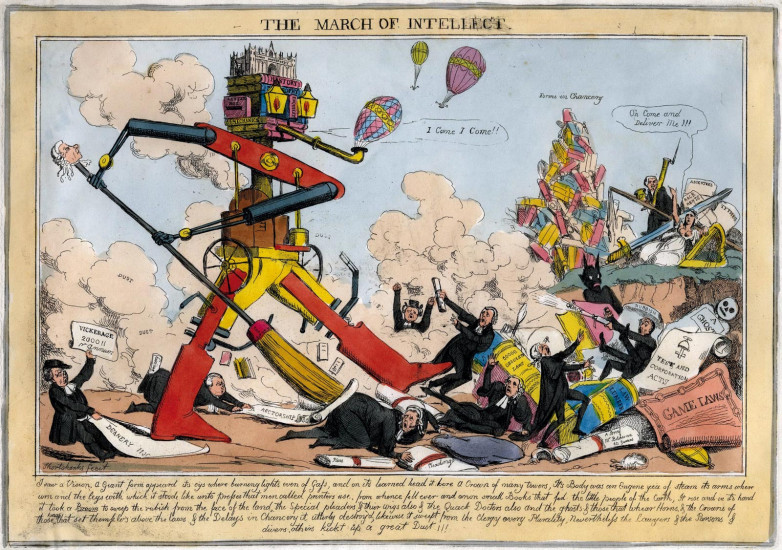
Robert Seymour, The March of Intellect (London, 1828)



A new exhibition at The Grolier Club explores the evolution of technology and its impact on labor through a close look at the history of printing.
The Second Printing Revolution: Invention of Mass Media will be on view in the Club’s ground floor gallery from January 14 through April 11, 2026, examining the transition from handcrafted book production to mechanized papermaking, printing, illustration, typesetting, and bookbinding. Curated by Grolier Club member Jeremy Norman from his personal collection, the exhibition features 150 books, prints, and artifacts from 1800 to 1904, with many rarities from England, France, Germany, and the United States. An accompanying catalogue will be available in January 2026.
The exhibition is organized into four main sections, Innovation (detailing steam-powered presses and papermaking), Diffusion (exploring the spread of early magazines and typesetting), Design (highlighting bookbinding and color imagery), and Scale (focusing on mass printing in America). Other elements include a spotlight on the railroad and mass market reading, women’s labor, and Charles Dickens.
Highlights include:
- a copy of the first issue of the daily London newspaper from November 29, 1814, printed on a double-cylinder steam-powered printing machine
- the educational reform group Society of the Diffusion of Useful Knowledge The Menageries (1829), the first extensively illustrated machine-printed book, featuring highly detailed woodcuts of animals
- Robert Seymour’s The March of Intellect (London, 1828), a satirical illustration about the social impact of groups like SDUK, featuring an automaton made of printing machine parts
- a 1794 French petition for a women’s typographic school, promoting an apprenticeship program
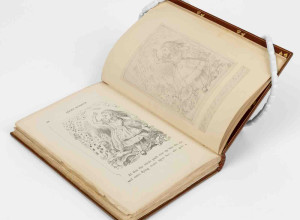
- Baxter’s Gems of The Great Exhibition (London, 1851) with brilliantly color-printed images that recorded the event printed on iron handpresses via an elaborate patented process
- an 1847 letter from Charles Dickens to his publisher Edward Chapman expressing hope that sales of a “Cheap Edition” of his works might reach a recordbreaking 100,000 copies
- an 1826 bible printed in Boston that was the first edition of the Old and New Testaments ever printed on a printing machine
“At the beginning of the 19th century, the Industrial Revolution had been underway in England for nearly a century, yet book production had hardly changed since Gutenberg’s invention of printing by movable type in the mid-15th century,” said Jeremy Norman. “This exhibition tells the story of the second printing revolution that took place during the 19th century as key inventions led to some of the first developments in mass production and the factory system, and ushered in a period of profound change in the socio-economic relationship between workers and employers.”