Declaring the Revolution: America’s Printed Path to Independence at The New York Historical
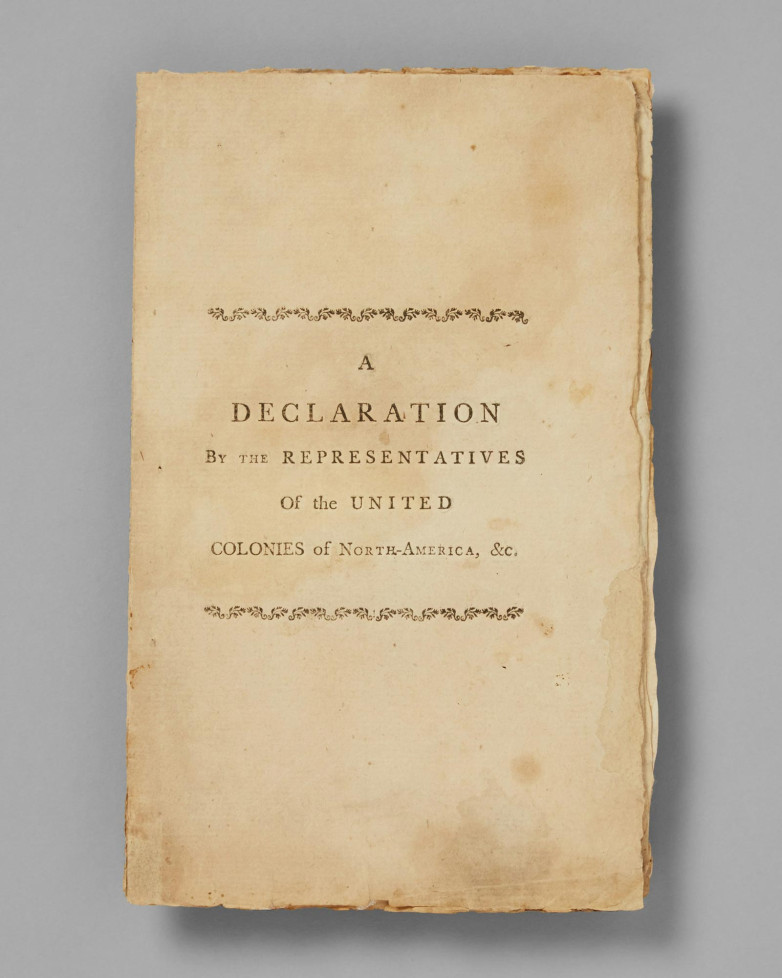
A Declaration […] Setting Forth the Causes and Necessity [of] Taking up Arms (Philadelphia: Bradford, 1775)



The current exhibition at The New York Historical focuses on the development of the ideas of the American Revolution through original printings and explores how their dissemination strengthened the push for American independence.
Running through April 12, 2026, Declaring the Revolution: America’s Printed Path to Independence; Historical Works from the David M. Rubenstein Americana Collection is among the many celebrations of the 250th anniversary of the Declaration of Independence.
A collection of 18th-century pamphlets, broadsides, engravings, proclamations, and books, reveal different aspects of how the colonies achieved independence. The highlights are two especially important printings of the Declaration, the very rare first newspaper appearance in the Pennsylvania Evening Post and the State Department engraving of the original engrossed copy.
Also on show are:
- Thomas Paine’s 1776 pamphlet Common Sense which called for independence from Great Britain
- John Hancock’s 1774 oration honoring the Boston Massacre confrontation between British soldiers and American colonists on March 5, 1770
- key texts which provided the intellectual foundation for the revolution such as printings of the Magna Carta, books by John Locke and Jean-Jacques Rousseau
“Declaring the Revolution traces the emergence of our nation through a shared belief in the power of the people and the promise of democracy,” said Dr. Louise Mirrer, president and CEO of The New York Historical. “Through historical printings, the origins of the ‘American experiment’ are on display, allowing us to reflect on how we live and fulfill the ideals of our nation today."
Declaring the Revolution shows that America’s goal of independence was not only a military conflict, but also a battle of ideas. The Virginia Declaration of Rights, drafted by George Mason in 1776, and shown in its uncommon earliest printing, outlines the requirement of natural rights that influenced subsequent documents like the Declaration of Independence. An exceptionally rare 1773 handbill printed by enslaved people in Boston asks that the language of freedom apply to them and points out the incongruousness of a land with bondage desiring to be liberated.
The exhibition is curated by Mazy Boroujerdi, special advisor to the David M. Rubenstein Americana Collection which mounts non-partisan exhibitions of historically important printings to foster civic engagement and historical understanding.
“The items on view bring new context to one of the most important documents ever written," said David M. Rubenstein. giving insight into the minds of our Founding Fathers as they changed the course of history. My reason for collecting these original printings is to show them to the public to give Americans an opportunity to encounter our country's impressive history and the accomplishments of those who came before us. To not remember these origins of our democracy is to risk losing our democracy.”