Bookseller Rhiannon Knol on Cataloging, Bookwomen, and Andreas Vesalius
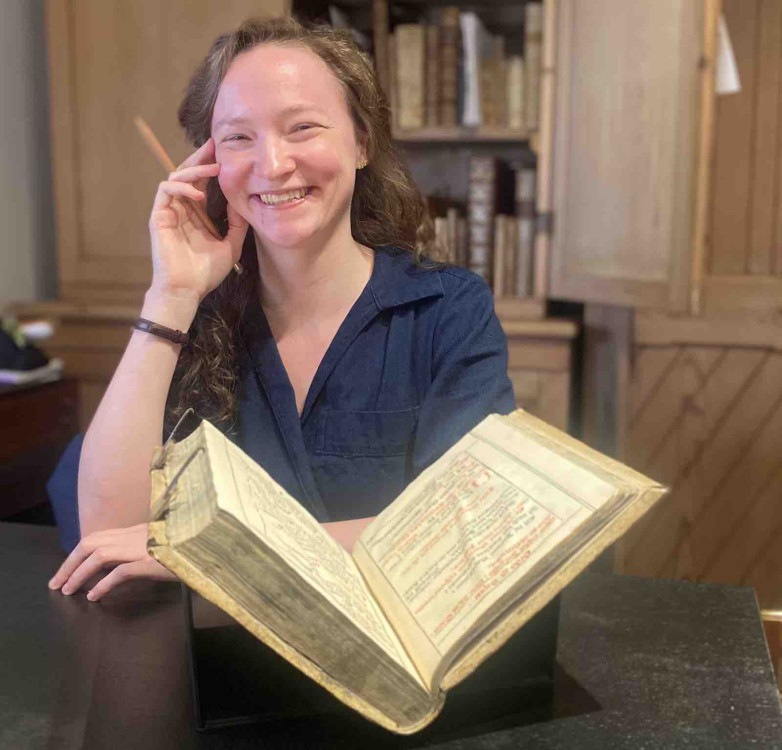
Rhiannon Knol



Our Bright Young Booksellers series continues today with Rhiannon Knol, a bookseller with Bruce McKittrick Rare Books in Pennsylvania:
How did you get started in rare books?
Studying classics as an undergraduate, I found myself asking the question: how did all this ancient literature get to me? I pursued a couple different lines of inquiry before I got to rare books. After I attended the Lincoln College Summer School in Greek Paleography, I was hooked! I went on to graduate school for classics, but ultimately found it a difficult fit for my interests. Luckily, I was adopted by Richard and Mary Rouse who set me up in the library working on their rare book collection. They were also collectors, and their stories about the adventures of buying rare books opened my eyes to a new potential career.
I quit the PhD program and ended up at the Getty Research Institute as the research assistant to their curator of rare books who had worked at HP Kraus before moving out west. We had a great deal of fun, culminating in the co-curation of the exhibition The Art of Alchemy in 2016-2017. I learned so much, and found my passion for Renaissance intellectual history and history. I know it’s common to feel, in the throes of a major project, that everything is relevant to your topic. But with alchemy, it’s really true! My search for actually gainful employment led me to take a job as a specialist in the books department at Christies in 2017. After seven eventful years, I left in 2024 to join McKittrick Rare Books.
What is your role at Bruce McKittrick Rare Books?
I am a bookseller; we are all booksellers here. The business specializes in European printed books and manuscripts up to the early 19th century and I focus on printed books. Of course I especially enjoy items dealing with classical reception and transmission, and right now I am particularly interested in Greek printing. But I get to do all kinds of things and that’s how I like it!
I am still relatively new, so learning the ropes of being a ‘real’ bookseller. There are a lot of basic similarities between what I did as a specialist at Christie’s and my current job, but also some major differences. I still spend a lot of time cataloging books and trying to convince people to buy them, but instead of appraising big libraries and pitching for collections, we buy books outright for stock. Auctions are big public events with lots of hard deadlines and moving pieces, while bookselling takes place on a more intimate, private level, and on its own time.
What do you love about the book trade?
On a very personal level, I love getting to know the books in a different way than I did as a student and scholar. When I catalog a book, I get to evaluate it for itself rather than for how it might be useful for some larger argument I’m making and think about the value in a different, more literal, way. I also love to see all the different ways our customers, from librarians and curators to collectors and fellow booksellers, relate to books as objects. I learn so much from them about the role books play in human life.
In a more general sense, the thing I love about the trade is the diversity of people’s training and experience. There are excellent booksellers without any formal training who simply learned by feel; there are also serious scholar-booksellers who seem to know every little thing about their area of the field. When I worked at Christie’s, every specialist in my department had a different degree, and when you walk the floor of a book fair, you’ll find that every person has a unique perspective to offer. It means there is always something to learn from the people around you… and hopefully something you can offer them in turn. I never really felt like I “fit” into academic classics or even the museum/library world. But among booksellers, there is a place for me.
Describe a typical day for you:
I am loving being able to take a short walk to work after many years of long urban commutes! The day can vary quite a bit based on the time of year or what we happen to be working on. Some days I come in and cloister myself in my office to catalog, interspersed with browsing the latest offerings of other booksellers or trips to the library. On other days, I might get immediately drawn into whatever my colleagues are doing in the front room—planning a list or a fair, evaluating a new arrival, or hashing out a thorny bibliographic mystery. Sometimes we even get a visitor
When we make a printed catalog, we have a contest for the image captions. We all come up with proposals for each illustration, and then meet to brainstorm and decide the winners by popular vote. It’s a really great pleasure to think, and joke, with my colleagues.
Favorite rare book (or ephemera) that you’ve handled?
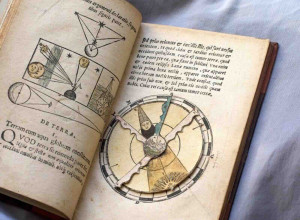
At Christie’s, I was privileged to get to handle and present for sale some very special objects. Highlights for me were Andreas Vesalius’s own annotated copy of the second edition of his Fabrica and the first appearance of the complete works of Plato, printed by the nuns of San Ripoli, from the Rosenberg Collection.
In my new job, however, I have the even greater privilege of really only working with books in the category that most excites me, early European printing, and each one is a little adventure in itself. A memorable book I worked on in my first year was an incunable called Ambition printed in the early 1480s in Florence. It is the first appearance of the Italian translation of Virgil’s Eclogues. But it is presented not as its own work, rather within a frame story about a man who is debating leaving the city for the countryside. The personification of Florence appears to argue for the city, and then Virgil himself appears to argue for the countryside.
His argument is the Eclogues, summarized in Italian. It’s a different way of thinking about the transmission of Roman literature. I was also thrilled to get to work with two books by Antonio Rocco, a prominent member of the rabidly Aristotelian atheist libertines known as the Accademia degli Incogniti. He wrote a sort of porno parody of Plato’s Symposium that is terribly funny. But his book on the soul, which argues for its bodily origin and thus the freedom to do with your body what you want, was his only work which appeared on the Index of Prohibited Books.
What do you personally collect?
I have a very modest collection of early books on classical transmission and Renaissance Platonism. In recent years, I’ve been more focused on what I call my “bookwomen” collection, works by or related to women incunabulists from the late 19th and early 20th century. It started as a Margaret Stillwell collection and sort of spiraled out from there. I am particularly interested in inscribed or presentation copies which reveal something of the networks these women live and worked in, or books from their own collections. Building it has taught me a lot about history of the trade and its relationship with libraries and collectors in mid-century America, and of course about the women who were making so much of it happen.
What do you like to do outside of work?
Like many booksellers, I imagine, the line between my work life and personal life is very porous. I’m involved in various bibliophilic societies and pursue my own personal projects where I can. My friend Jason Dean and I write a monthly newsletter on bookish topics called Half Sheets to the Wind. Is that outside work? Hard to say! But especially since moving to Philadelphia I do try to stake out some truly personal pursuits. I love to garden and cook. Recently a bookseller friend and I recreated a recipe by the 17th century Mexican nun Sor Juana de la Cruz… but wait, is that outside work? I try to get out to the theater, ballet, and opera as much as I can, and my partner and I regularly practice yoga together. Oh, and I have a terrible weakness for 'academic thriller' novels.
Thoughts on the present state and/or future of the rare book trade?
I know that booksellers have been complaining about the state of the trade for at least as long as they have existed. The landscape is always changing, and I don’t think that’s necessarily a bad thing. I enjoy the work of interpreting and presenting antiquarian books to new audiences. I am grateful for the internet which has totally transformed bibliographic research through the ability to consult digital facsimiles of multiple copies of a book at the touch of a finger.
I’m sure I’m not alone in my worry about the future of the study of the humanities in this country which has been under threat for a while and direct attack recently. The importance of the study of history, literature, languages, and the arts in relation to rare books can’t really be overstated. We all exist in a delicate ecosystem with each other. But in a way, it does make the careful description of rare material and the escorting of them to new homes feel even more precious. Bookselling isn’t saving the world, but it is participating in the care of the past.
Any upcoming fairs or catalogs?
We recently put out a e-list called Uncovering Antiquity, which features books about the major undertaking of recovering a lost history, from ancient texts to Renaissance archaeological reports to 19th century scholarly libraries. Keep an eye out for our printed Catalog 75, currently in production (the business has been in operation since 1979). You will also find us at the Boston International Book Fair November 7-9 (booth 405) and Toronto Antiquarian Book Fair, November 14-16.